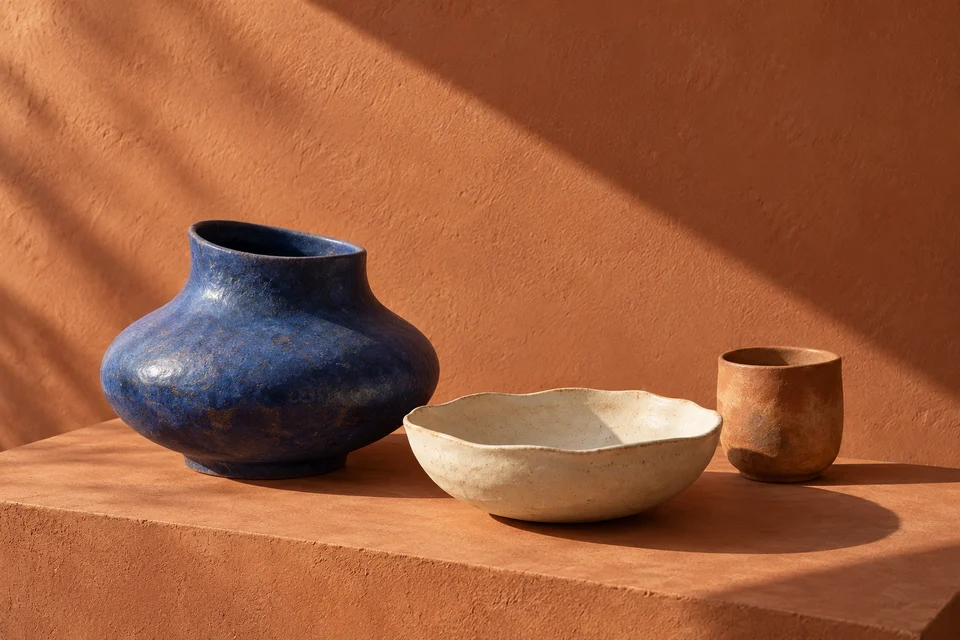
Draw the space, then reveal the piece.
The print study uses a vase-shaped opening against cobalt. A simple stem gives that opening a purpose. The same use leads into the object page, with no elaborate reveal required to see the product.
STUDIO EXPLORATION / Craft & digital catalogue / Mexico
Room for one good thing.
A vase is also a space waiting for a stem. A bowl makes room for the things you reach for every day. We imagined a Mexico City ceramics catalogue that starts with what an object leaves open, then shows the piece itself.
An imagined business. A considered direction. This is a self-initiated studio exploration. It is not a commissioned client project, a live business or a claim of measured results.
Give a small ceramics catalogue a distinctive organising idea that connects an object’s form to its place in daily life.
People choosing objects for a home and designers comparing proportions, finish, availability and suitability for a space.
01 / THE QUESTION
A sculptural photograph can make an object desirable without helping someone imagine living with it. We wanted this catalogue to begin with an ordinary use: a stem, a place for keys or the first coffee of the day.
The unusual part is to introduce the space an object makes before its silhouette. The useful part is to connect that invitation to an identifiable piece, with clear dimensions and a contextual enquiry.
02 / THE ABSURD ANGLE
Begin with the space someone already owns. The empty-space shop uses width, depth and height to narrow an illustrative catalogue, leaving room around each object. Negative space becomes both the visual identity and a useful shopping tool. A piece that does not fit is allowed to lose the sale. Real production would also require reliable measurements, weight, tolerances and shelf-safety guidance.
The print study uses a vase-shaped opening against cobalt. A simple stem gives that opening a purpose. The same use leads into the object page, with no elaborate reveal required to see the product.
Use-led choices sit beside ordinary object names. A buyer looking for a vase or a bowl can go directly there, with dimensions, material, finish and availability close to the photograph.
The selected piece travels into the enquiry with quantity, destination and timing to be confirmed. A real studio would approve all object uses and specifications, with native editors for Spanish and English editions.
03 / THE NEXT DECISION, UP CLOSE
Browse by the small use you have in mind, then see the object. Conventional object names, dimensions, finish, care and availability stay in view, with a specific enquiry for the piece.
TRY THE IDEA / The empty space shop
Start with the space you have. This miniature catalogue makes room dimensions part of choosing an object, before you fall for its photograph.
Working studio prototype. Illustrative products and services, with no booking, order or data submission.
From a material direction to a recognisable invitation.
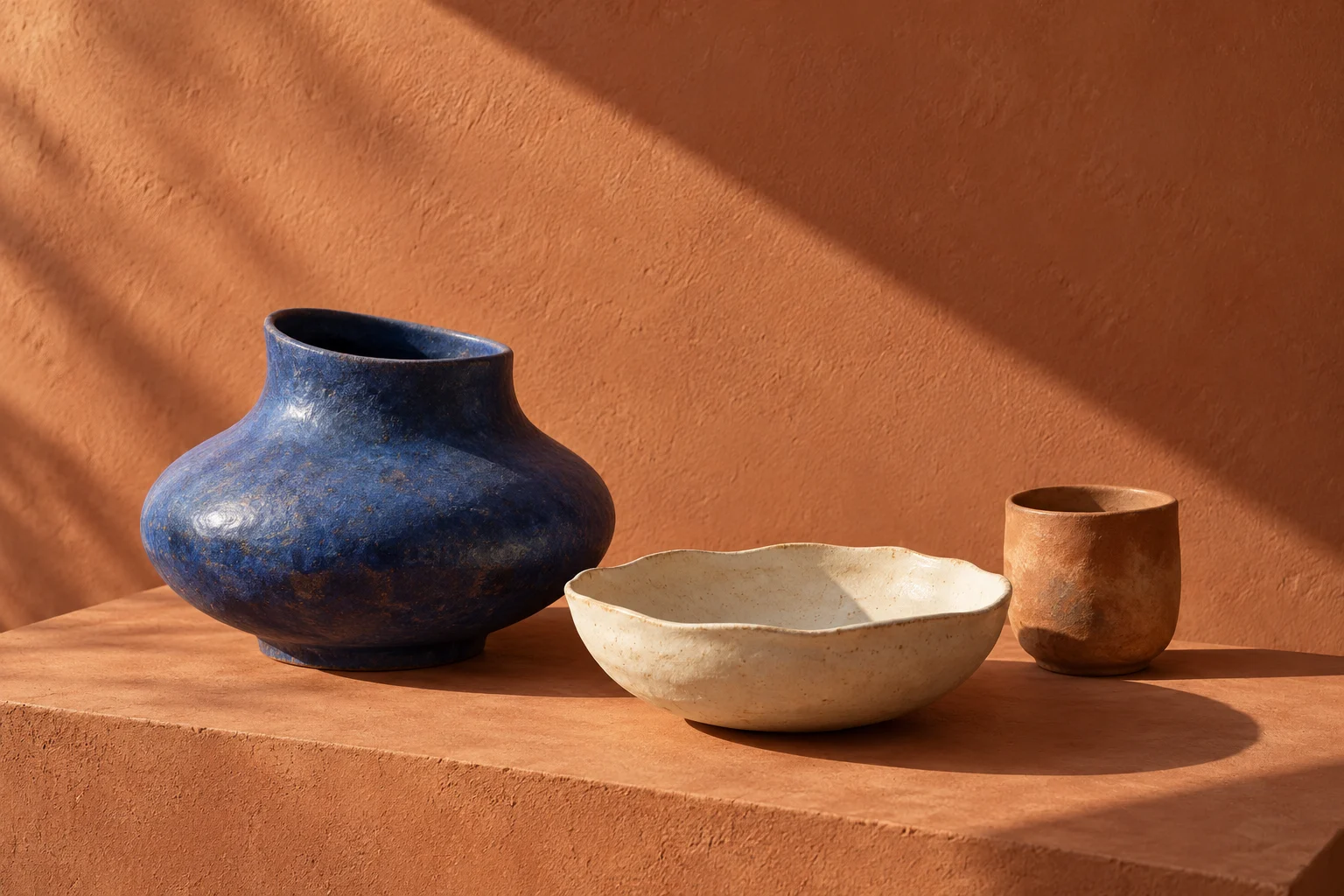
Original generated objects and setting for the fictional Mexico City studio. A visual direction, not a photograph of a real maker’s work.
A vase-shaped opening in a cobalt field, with a single stem. The empty space introduces the use of the object before the catalogue introduces the piece.
THE VISUAL LANGUAGE
A generous editorial scale with simple object labels. Spanish sample interface copy sits within a layout planned for genuine language-specific content.
04 / THE OUTPUT & ITS LIMITS
A ceramics identity built from what the objects leave open. Negative-space print and a use-led catalogue carry the same idea, while familiar product details give a buyer something concrete to enquire about.
Evidence statusForma Sur is a fictional studio. The ceramics and setting are original AI-generated concept imagery, not works by a real maker or evidence of a production process. The catalogue has not been tested or launched.
A production project would also need to:
THE WORK, PROPERLY CREDITED
A QUESTION FROM YOUR OWN BUSINESS?
ANOTHER POINT OF VIEW
Explore the next studio project, or bring us a question from your own business.
Let's talk about your project ↗← All workA fictional retreat with an itinerary of absolutely nothing. A hospitality website and identity study that makes an unplanned day the reason to book.